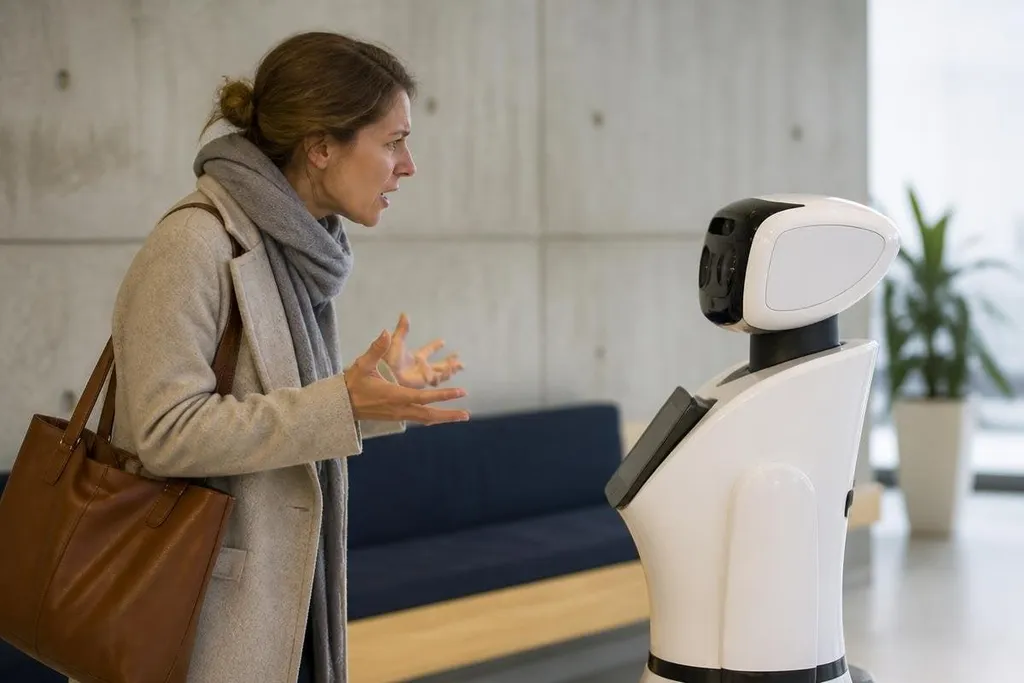
A robot can detect a raised voice, a turned face, or a person stepping away. It still can't know with confidence whether that person is angry, tired, afraid, or in a hurry. That gap makes emotional AI harder to use in a robot than in a phone app.
- Sensors read signals, not feelings
- The same gesture can mean different things
- Wrong guesses can change how a robot treats someone
What emotional AI asks a robot to do
Emotional AI gives a robot software that estimates a person's mood or state from visible and audible signals. A camera may track facial movement, while a microphone measures speech patterns, volume, and pauses. The robot then chooses a response from that estimate.
The process has three parts: sensing, inference, and action. Sensing collects data. Inference turns that data into a label such as calm or upset. Action changes the robot's words, speed, distance, or task.
That last step raises the stakes. A wrong label inside a photo app may be harmless. A wrong label from a care robot, security robot, or workplace system can make a person feel watched, ignored, or pressured.
Why the signals are hard to read
Facial movement has no fixed meaning. A smile can show joy, politeness, discomfort, or an effort to calm another person. A quiet voice can mean sadness, concentration, illness, or a noisy room that makes speaking difficult.
The robot also sees only part of the situation. It may miss a person's words, know nothing about an earlier event, or mistake a cultural habit for an emotional sign. A model trained on one group of people can make more errors with another group if its training data lacks enough examples.
Language adds another problem. People use dry humor, indirect requests, and unfinished sentences. A robot that treats every phrase as a direct statement may respond in a way that feels cold or out of place.
A wrong read of tone can turn a pause into consent or a calm reply into refusal. Dated emotional AI robot reports can help you compare those claims with named machines, test settings, and results.
The cost of a wrong guess
Emotional labels can affect access to service, attention from staff, or the way a robot handles a task. That makes the system's error rate more useful than a smooth demonstration. You need to know when the robot gets confused, how it shows uncertainty, and who can correct it.
A robot should not hide doubt behind a confident voice. It can ask a person to repeat a request, switch to a neutral response, or call a human operator. Those choices keep the system from turning a guess into a decision.
Privacy also starts before the robot speaks. Cameras and microphones may collect data from people who never agreed to take part. A deployment needs clear rules for storage, access, deletion, and notice. If the robot records a room, people should know what it records and why.
I'd keep emotional AI in a supporting role until a team can show how it handles wrong guesses in the setting where it will work.
What a useful system should show
A serious product brief should explain the sensor inputs, the labels the software uses, and the action tied to each label. It should also show tests with different voices, faces, lighting conditions, distances, and background noise.
The robot needs a safe fallback. A neutral reply is often better than a false claim about someone's feelings. Operators should be able to review a decision, correct the label, and stop the emotional response without stopping the whole robot.
The strongest test is not a polished demo. It is a recorded set of ordinary interactions where the robot states its uncertainty and the team reports errors instead of hiding them.
A buying checklist
Before approving an emotional AI system, ask:
- Which signals does it collect, and from how far away?
- What emotional labels can it assign?
- What happens when the confidence is low?
- Can a person correct or override the response?
- How long does the system keep audio, video, or derived labels?
- Which people and settings were included in testing?
Those answers tell you whether the robot is reading useful context or attaching a neat label to messy human behavior. The open question is whether vendors will publish enough error data for buyers to judge that difference before deployment.